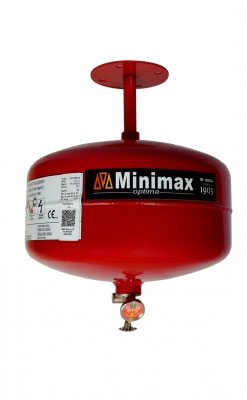


Clean Agent Ceiling Mounted Type
| Specifications | 5 kg | 6 kg | 10 kg | 12kg |
| Working Temperature °C | -30 °C to + 60 °C | |||
| Cylinder Testing Pressure | 35 bar for 30 sec. | |||
| Operating Pressure | 8 bar | |||
| Bulb Temp. | 68 °C Standard | |||
| Area Coverage | 3 x 3 mtr. | |||
| Propellant | Dry Nitrogen | |||
| Charge | Grenoz® / FK 5-1-12 | |||
Minimax Clean Agent Ceiling Mounted Fire Extinguishers In today's technology-driven world, safeguarding sensitive equipment and data from fire hazards is paramount. Minimax addresses this need with its state-of-the-art clean agent ceiling-mounted fire extinguishers, designed for automatic activation and effective suppression without causing collateral damage.
Key Features of Minimax Clean Agent Ceiling Mounted Fire Extinguishers
● Automatic Activation: Equipped with a heat-sensitive bulb that activates at 68°C, ensuring timely response to rising temperatures.
● Residue-Free Suppression: Utilizes GRENOZ® clean agent, which leaves no residue, preserving the integrity of sensitive equipment.
● Eco-Friendly Fire Safety: GRENOZ® is an environmentally friendly agent with zero ozone depletion potential, aligning with sustainable safety practices.
● Wide Coverage: Designed to cover areas up to 3x3 meters, making them suitable for various room sizes.
● Robust Construction: Built to withstand temperatures ranging from -30°C to +60°C, ensuring reliability in diverse conditions.
Types of Clean Agent Ceiling Mounted Fire Extinguishers
Minimax offers multiple models to cater to different protection needs:
1. 5 kg Model:
○ Coverage Area: Up to 9 square meters.
○ Ideal For: Smaller rooms like server closets or compact storage areas.
2. 6 kg Model:
○ Coverage Area: Up to 10.8 square meters.
○ Ideal For: Medium-sized spaces requiring reliable fire suppression.
3. 10 kg Model:
○ Coverage Area: Up to 18 square meters.
○ Ideal For: Larger spaces such as open-plan offices or extensive storage facilities.
4. 12 kg Model:
○ Coverage Area: Up to 21.6 square meters.
○ Ideal For: Expansive areas with critical equipment needing comprehensive protection.
Why Choose Minimax's GRENOZ® Clean Agent Extinguishers
● Advanced Detection: The integrated heat-sensitive bulb ensures fires are detected and suppressed promptly.
● High-Quality Agent: GRENOZ® is a UL-approved clean agent that effectively suppresses fires without harming sensitive equipment.
● Eco-Friendly Fire Safety: GRENOZ® has zero ozone depletion potential and low global warming potential, making it a sustainable choice.
● Durability: Constructed with materials that resist corrosion and wear, ensuring longevity.
● Compliance: Meets stringent safety standards, providing peace of mind to users.
Integration with Other Fire Safety Solutions
Minimax's clean agent ceiling-mounted fire extinguishers can be seamlessly integrated with other fire safety systems:
● Dry Powder Ceiling Systems: For areas with diverse fire risks, combining with dry powder ceiling systems ensures comprehensive protection.
● Fire Alarm Systems: Integration with fire alarm systems allows for immediate alerts and coordinated responses during fire incidents.
Related Products
.jpg)
.jpg)
Frequently Asked Questions
Fire extinguishers should be located throughout the workplace and readily accessible to the employees without subjecting them to possible injury. Selection and installation vary site to site and hazard to hazard. General Placement distance as per the class of fire as per IS 2190 is mentioned below;
- Class A, B and C Fire Hazard – Fire Extinguisher within 15 m travel distance.
- Class D, F and Special Fire Hazard – Fire extinguisher within 10 m travel distance.
The knowledge of operating fire safety equipment and how to act during a fire emergency is of utmost importance as it equips the employees with the knowledge and skills to about the fire emergency procedures. Fire safety training shall be carried out every 12 months. In some critical circumstances, organization shall provide additional training. Factors that may prompt this include: An incident occurs in your industry/workplace, which impacts on your business and safety procedures.
Preparation is the key to an effective response to workplace fires. Fire drills are ways to prepare for exiting a building or performing emergency procedures during a fire emergency. Fire drills help prepare employees to respond quickly, calmly, and safely. Fire & emergency drills shall be conducted, in accordance with the Fire Safety Plan, at least once every six months.
Flammable liquids, solvents and gases, waste products, combustible materials, Oxidising chemicals, Pyrotechnics, Sparks, Hot work, Extractor fans, Conventional heat sources like HVAC and radiators, Frictional heat and static from machinery, electrical hazards due to exposed wires, overloaded circuits, static discharge and extension cords, faulty electrical equipment and machinery, activities such as welding and grinding, and anything that involves molten metals, etc. are an identified fire risks in an industrial environment.
Flammable liquids, solvents and gas storage, combustible material waste, Uncovered or unprotected fuel, electrical circuits, heating equipment, and smoking materials can also cause fires. Fire potential is less for Warehouse when compared to the industry. But when a fire incident occurs happens it is on a massive scale.
While you might think that your office is free from combustibles because there are no oils, gases or open flames, there are still risks present in any commercial building. Paper, wooden furniture, plastics, tissues, cleaning liquids, and even dust can catch fire. Electrical hazards such as exposed wires, overloaded circuits, extension cords, faulty electrical equipment and unprotected combustible materials are the primary risks for a fire breakout in offices.
Fire safety standards generally focus on minimizing the reaction to fire of products and materials used in different living environments such as domestic dwellings, household equipment, furnishings and electronics, buildings and different transport modes. Globally, most fire safety regulations have policies and procedures in effectively storing, managing, and disposing of fire initiating materials or activities. Different fire standards such as NFPA, NBC, BIS etc. are followed by the organizations for fire safety compliance.
BIS (Bureau of Indian Standards) has a guideline mentioning a small band of distinguishing color shall be prominently visible on the surface area of fire extinguishers. As you are aware that different types of extinguisher are suitable for specific classes of fire, band colour identifies the type of fire extinguisher and its suitability on different classes of fire.
The most feasible fire safety equipment required to have are fire extinguishers. The fire extinguisher equipment should be easily identifiable, highly visible, easily accessible, adequately charged, and regularly inspected. They should be placed high on wall surfaces and positioned near to the closest exit.
A fire risk assessment is a review undertaken of a building, office premises, or commercial complex in order to assess its fire risk and offer recommendations to make the building safer. It is a legal requirement. Any structure where people are dwelling as part of a commercial activity must have this done. The risk assessment is done by a fire safety authority from local fire service department with fire safety education, training and experience.
A qualified fire authority inspects a premise as part of a periodic fire risk assessment. The enforcement officer evaluates the fire standard compliance at the workplace and identifies the potential areas of improvement. The evaluations also reinforce the policies to ensure that no fire accident happens. The inspection verifies the efficiency of the existing fire prevention measures.